


In the transport industry, it is rare for a single system to cover everything. The vehicle has its own, the driver has their own, and the dispatcher sits with yet another - and far too often, people have to stitch the information together themselves. Between FleetX and Tracksys, we have done something about that.
Through close collaboration and a deep integration between the two systems, data flows freely between vehicle, driver and dispatcher - in real time. The result is that the entire transport chain can be managed from one place, without important information being left behind in silos.
In this article, we show what the integration actually does in everyday operations - and why we believe no one else in the industry can point to a system this broad and complete.
It starts with the obvious, but also the most important thing: the dispatcher needs to know where the vehicles are. In the FleetX dispatch view, all vehicles are shown directly on the map with real-time data from Tracksys - position, heading, speed and which driver is behind the wheel.
This means the dispatcher does not have to switch between systems to understand the status of the fleet. When a customer calls and asks where their load is, you have the answer straight away. When a new order comes in, you can see immediately which vehicle is nearest and best placed to take the job.
One of the most time-consuming tasks in transport is time tracking - and it is also where most of the friction arises between driver, dispatcher and payroll. This is where the integration makes a big difference.
Tachograph data is pulled in automatically from Tracksys and used as the basis for the timesheet in FleetX, between clock-in and clock-out in the FleetX app. The driver no longer has to log hours manually, and the dispatcher gets a timesheet that actually matches what the vehicle has done.
In the overview you see every activity - driving, breaks, other work - with exact times and durations, linked to the correct vehicle. Regular working hours, flexitime and evening supplements are calculated automatically based on the rules that apply to the driver.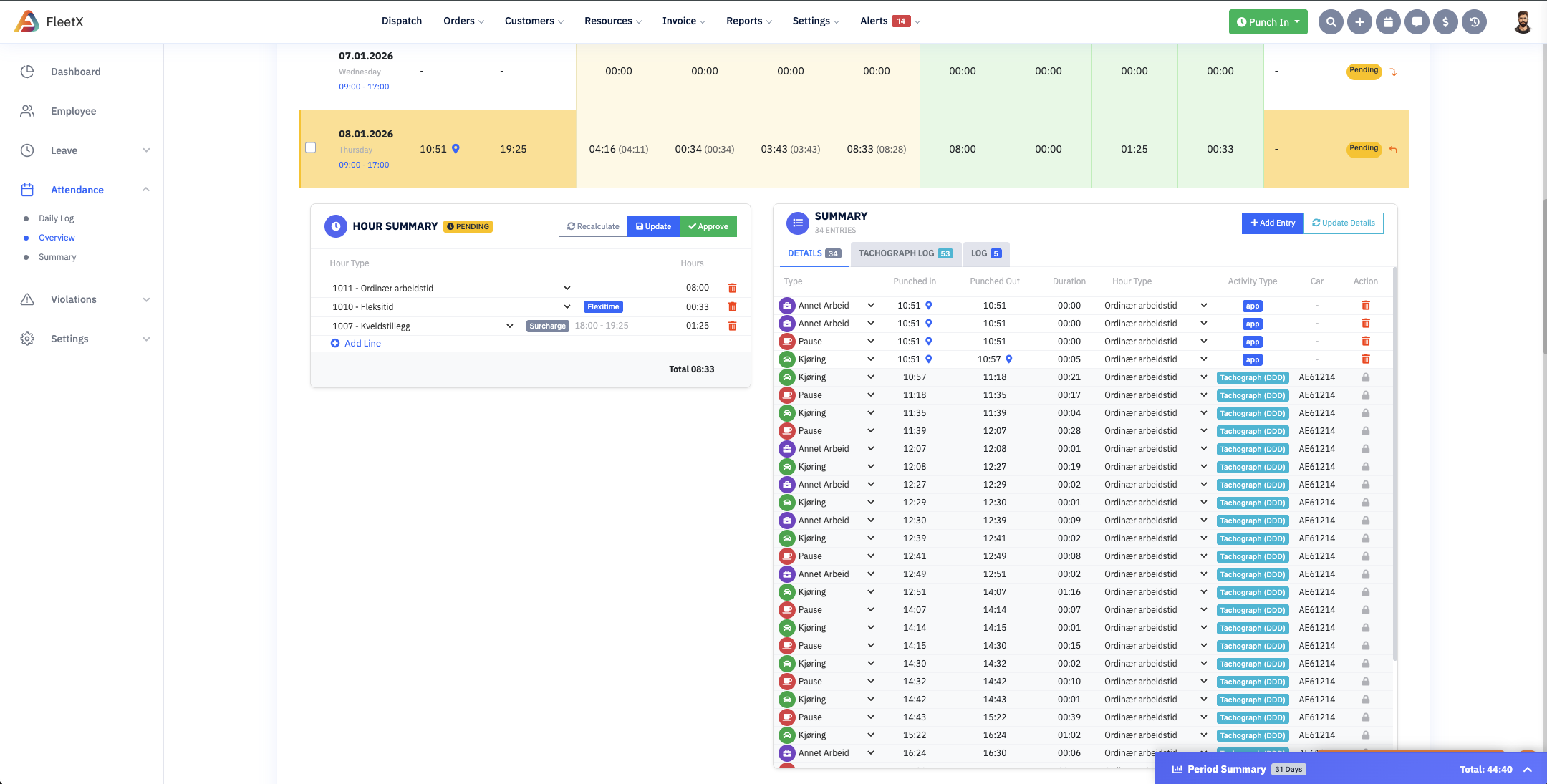
For the driver, the FleetX app is the starting point for the entire working day:
- Job information with addresses, contact persons and comments
- Clock-in and clock-out with automatic time records
- Absence registration
- Handling of driving and rest time infringements
The last point is particularly important. When the tachograph records an infringement, it appears in the app so the driver can comment on and explain the event immediately - not several weeks later when someone is trying to reconstruct what happened. That makes follow-up far easier, both for the driver and for the transport manager.
This is where the integration goes a step further than most TMS solutions. For every route in FleetX, the dispatcher gets a complete financial overview - not just the order price, but the full cost picture.
In the image below, you can see what a typical route looks like: the order price is 13,000 NOK (Norwegian kroner), resource costs (driver wages) are calculated at -6,303.50 NOK, and vehicle costs - fuel, leasing, insurance and the like - are calculated at -212.19 NOK based on data from the Tracksys module. That gives an estimated result of 6,484.31 NOK, or a 49.9% margin.
These are estimated figures before the route has been completed. Once the driver has delivered the last stop, the numbers are updated with actual data - actual fuel consumption from the vehicle, actual driving hours from the tachograph, actual waiting times. That means you are not just planning for profitability - you know how profitable it actually turned out to be.
For an industry with tight margins, this is a game changer. You can see which routes pay for themselves, which customers are actually profitable, and where there is room for improvement.
For hauliers carrying chilled and frozen goods, the cold chain is everything. A single breach can mean the entire load has to be discarded, and that the customer loses trust.
Through the integration, FleetX pulls in temperature data from the reefer unit on the vehicle and links it directly to the order. You get a complete report showing:
- Set point, supply air and return temperature for each compartment
- A continuous temperature curve from collection to delivery
- Any deviations clearly marked on the curve
- An event timeline with arrival, loading and delivery - with the temperature recorded at each point
The report can be sent directly to the customer as documentation that the cold chain has been maintained. No manual printouts, no digging through logs from the vehicle - everything is connected from the start.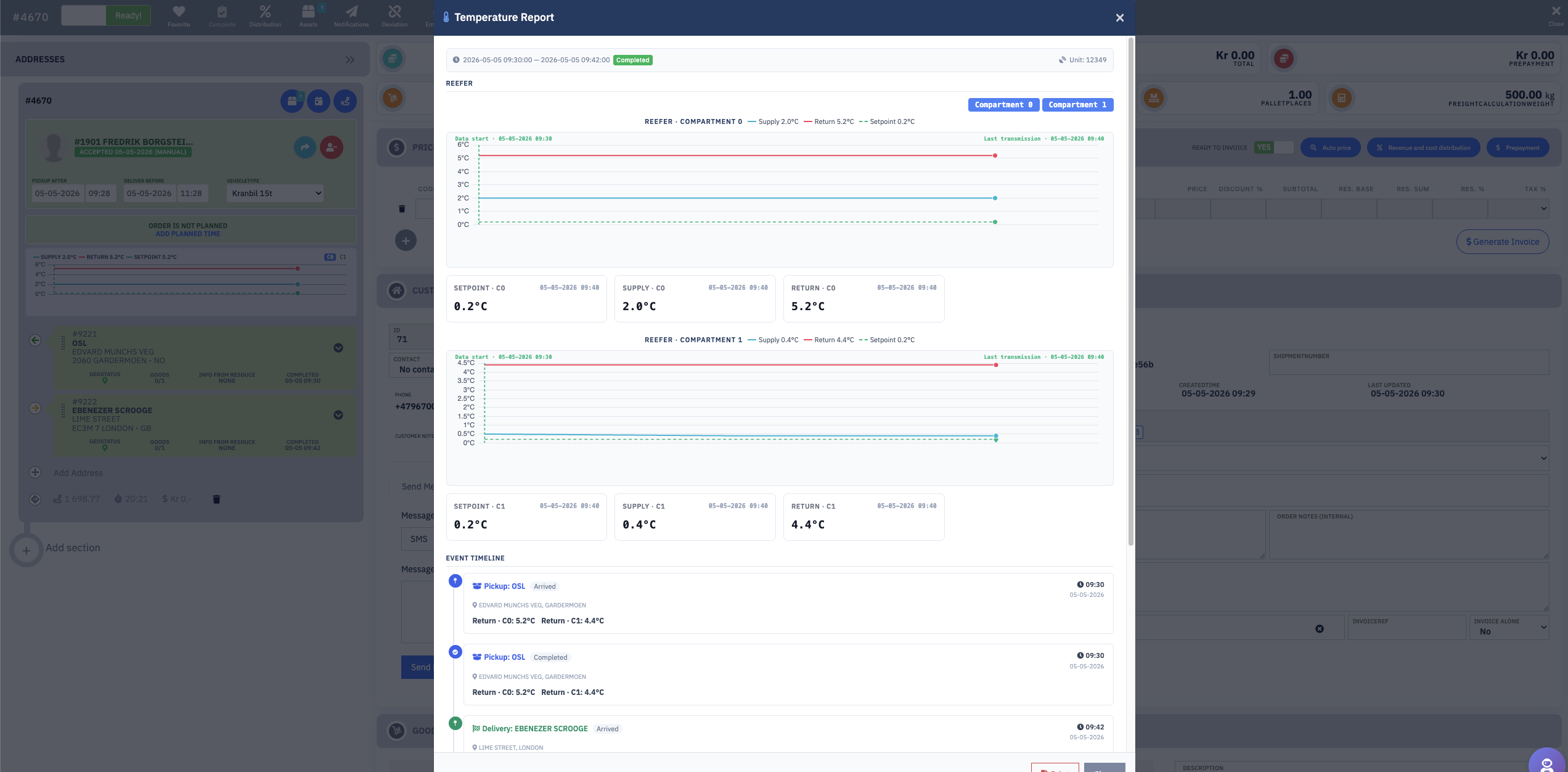
There are many suppliers in the industry offering parts of this. Some have good fleet management. Some have good time tracking. Some have good route economics.
What makes the partnership between FleetX and Tracksys special is the breadth - and the fact that two different systems actually manage to share the data that matters to the haulier. Not through an export once a day, not through a spreadsheet run manually, but in real time:
- Position data from the vehicle → map in dispatch
- Tachograph data → timesheet and driving/rest time monitoring
- Fuel consumption → route economics
- Temperature from the reefer → order documentation and customer report
It is this flow that gives the dispatcher the full overview - and gives the driver one place to go.
We dare to claim that no other solution in the industry can point to a system as broad and complete as what FleetX and Tracksys deliver together. Not because we have the most features - but because the features actually fit together, and because the data flows to where it needs to be, when it needs to be there.
For the transport company, that means simpler working days, better decision-making and profitability that is genuinely measurable - not estimated after the fact.
Want to see what the integration between FleetX and Tracksys could look like for your business? Try FleetX or read more case studies.
Book a free demo and one of our team will walk you through FleetX, tailored to your operation. No commitment, no credit card.
Book a demo